Showing posts with label Professional Reading. Show all posts

Friday, August 6, 2021

Professional Reads Series - 5 Kinds of Nonfiction - 8.06.21

When I think back over my teaching the past five years, the area I have grown the most in is my knowledge of nonfiction.  I owe so much of that to author Melissa Stewart.  Through her blog, her books, her social media posts, and luckily enough, through in-person conversations, my understanding of nonfiction, the structures of it, how it fits into my everyday teaching, how I teach it, has all been impacted by her.  I'm so glad that this new book, specifically meant for educators, exists in the world!


5 Kinds of Nonfiction: 
Enriching Reading and Writing Instruction With Children's Books
written by Melissa Stewart and Marlene Correia
published by Stenhouse Publishers


This really is a book teachers will want to take the time and read.  It's a quick read, I love the way it's organized with separate boxes for activities and teaching ideas.  The full-color photographs brighten up the look and the many, many, many book covers will give you loads of ideas of nonfiction picture books you'll want to add to your collections or know what to get at the library (and full disclosure, I had the pleasure of taking many of the photographs - it has been so fun seeing past students in the pages of this book).  While the nonfiction standards have given some direction in teaching nonfiction, I know there is more work to be done to really teach readers how to approach, read, and understand nonfiction.  We spend so much time with fiction, but don't always give the same amount of time to nonfiction.  Maybe it's because of our own biases.  This book will break down nonfiction picture books and it will lead to some great enthusiasm to get into classrooms and share what you've learned with your learners!

Here are just a few reasons you'll want to add this book to your professional library:
  • included in the book are description cards of the 5 kinds of nonfiction.  They can be printed up and used as a quick thumbnail or blown up and put on posters for all students to refer to.  They are easy to understand and have book covers to help associate titles with the nonfiction type.
  • it has direct correlations to so many parts of your curriculum.  I love the ideas about how this helps students understand what types of books to choose when getting ready to research.  I love the chapter about text structure.  It is so vitally important for readers to be able to note text structure.  It helps readers understand the point the author is trying to get across to readers, and since authors choose their text structure very specifically, it helps organize their writing.  There is a dedicated chapter just for this information!
  • lots of great ideas about noticing how authors craft their sentences that gives readers really important information about the topic.  I know teachers talk about craft moves with writing and Melissa Stewart has picked out some great lessons to go along with this!
  • loads of activity ideas in every chapter.  Step by step directions are given that make perfect lessons.  There are activities that correspond across the curriculum!  This alone should convince you to check out the book!  A favorite one gives some questions (broken down to k-1, then grade 2, grade 3, etc) that can be asked after reading a nonfiction picture book to readers that really gets into the content and the author's craft/decisions.

I am honored that Melissa stopped by the blog to talk a little more about her book!  I'll let the expert tell you even more about her work.

Five Kinds of Nonfiction: A Q&A with Author Melissa Stewart


MK: Can you tell us a little bit about the 5 Kinds of Nonfiction?

MS: We’re used to subdividing fiction into categories like mystery, science fiction, realistic fiction, and historical fiction, but in the past, we’ve just lumped all nonfiction together. The 5 Kinds of Nonfiction classification system brings clarity to the wide world of nonfiction by breaking it down into groups with specific traits.
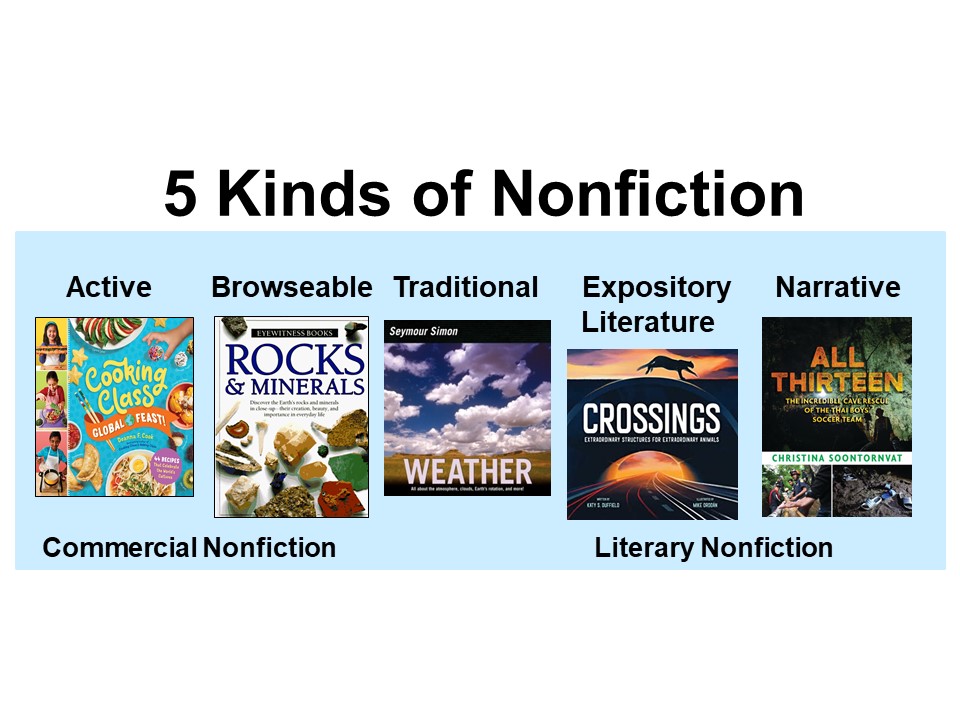
Once students understand the characteristics of the five categories—active, browsable, traditional, expository literature, and narrative, they can quickly and easily determine the kind of information they’ll find in a book, predict how the information will be presented, and identify the kind(s) of nonfiction they enjoy reading most.


MK: What made you want to create this classification system for nonfiction?


MS: I developed this system for myself, so that I could better understand the nonfiction market and determine what kinds of manuscripts publishers would be most likely to acquire. 


I began thinking about ways to classify books in 2012, but it wasn’t until 2017 that I came up with the 5 Kinds of Nonfiction. I posted it on my blog to see if it resonated with anyone else, and the response was incredible. To date, that original blog post has received more than 500,000 hits. 


Because so many people find the system useful, highly-regarded literacy educator Marlene Correia and I wrote the recently-published book
5 Kinds of Nonfiction: Enriching Reading and Writing Instruction with Children’s Books.


MK: Why is categorizing nonfiction important?


MS: It helps teachers and students identify the best books for a particular purpose. 


Active nonfiction is ideal for makerspaces. 


Traditional nonfiction is the best choice for early in the research process when students are “reading around” a topic. 


Once students have focused their topic, they should begin looking at browsable nonfiction. It’s full of text features that allow students to easily find specific information. It’s also bursting with fun facts that can enrich student writing. 

Expository literature makes the best mentor texts for informational writing because it typically features a strong voice and rich language. 


MK: What types of nonfiction texts are most valuable for teachers and students? 


MS: All 5 Kinds of Nonfiction are valuable in the classroom because different students are naturally drawn to different kinds of nonfiction books. Here are some examples:

“I like browseable books because you have a lot of choices about how you read. It’s  like the potluck dinners at my church. ” —Matthew, fourth grader


“I like narrative nonfiction because it has  characters and a story that’s a real situation.”—Miles, second grader


“My favorite category is active nonfiction because you get to do things while you
read. That makes me feel calmer.” —Jack, fourth grader


“I like expository literature because it has facts plus it can make you think about
something in a new way.” —Rowan, fourth grader


Students need to be exposed to a broad range of nonfiction as read alouds and in instruction. Teaching with text sets offers every child something they can sink their teeth into. Ideally, these set will include radio interviews, podcasts, and documentaries as well as all 5 kinds of nonfiction—and fiction too. The book Text Sets in Action by Mary Ann Cappiello and Erica Dawes is a great resource for creating these kinds of lessons.


MK: In your article "The Five Kinds of Nonfiction for Kids" you cite the fact that up to 75% of students "enjoy expository nonfiction as much as or more than narratives." I think this may surprise some adults. Why do you think kids enjoy expository text so much? 


MS: People of all ages love facts, stats, ideas, and information! That’s why the TV show Jeopardy! so popular, and it’s the reason the Guinness Book of World Records is a best-seller year after year. 


In the adult publishing world, nonfiction sales are strong because when readers have the power to select their own books, they often choose nonfiction. Why should children’s reading preferences be any different? 


MK: If a child is new to reading nonfiction, where do you suggest they start?


MS: With a topic that fascinates them. All children are naturally curious. It’s so important to offer them a steady diet of nonfiction titles that can fuel their passion for learning about the world and their place in it.


MK: What resources do you suggest for educators who would like to learn more about the Five Kinds of Nonfiction and diversifying their collection?

MS: To get started, there are some useful resources on my website. For a more complete overview that includes dozens of easy-to-implement instructional ideas, I recommend reading 5 Kinds of Nonfiction: Enriching Reading and Writing Instruction with Children’s Books.


Melissa Stewart
has written more than 180 science books for children. She co-wrote 5 Kinds of Nonfiction: Enriching Reading and Writing Instruction with Children’s Books and edited the anthology Nonfiction Writers Dig Deep: 50 Award-winning Authors Share the Secret of Engaging Writing. Melissa maintains the award-winning blog Info-licious Inspiration and is available for school visits and professional development workshops.


I know this is a book you'll want.  I'd like to share a copy with you and your school (US addresses only).  If this is a book you would like to read and share with colleagues, be sure to enter the giveaway by Aug. 12th.


Friday, July 16, 2021

Professional Reads Series - Nonfiction Writers Dig Deep - 7.16.21

Let's just say it.  It was a difficult year last school year.  It was difficult to read.  It was hard to focus.  Every last bit of attention had to go to what you were presently doing.  I think there is going to be a lot of PTSD recovery that is going to need to happen way longer than a summer break can offer!  I did not do any professional reading last year.  I had intentions, but there just wasn't a chance I could give an extra thought other than to what I was doing.  So, trying to make up for some time this summer!

I'm hoping to review a few before we all head back to school.  My goal as I read them was to be thinking about how does this translate for me?  As a teacher?  As a coach?  As someone who works with large groups and small groups of readers?  As I write up my review, those are things I wanted to let blog readers know about.
The first book I read:

Nonfiction Writers Dig Deep by Melissa Stewart
Nonfiction Writers Dig Deep
edited by Melissa Stewart
published by NCTE


This one has been in my possession for awhile, and I'm sorry it took me so long to get to, but, as mentioned, covid, so yeah.

This book was a bit different from the other professional books I read because it was written by authors instead of someone in the professional development field.  That made it a unique read right away.  Nonfiction author Melissa Stewart, brings together 50 award-winning children's book authors to explain their nonfiction writing process and what keeps them writing.  There are three main topics: choosing a topic, finding a focus, and making it personal.

Before I explain any further, this is not a book that is celebrating the authors' finished books.  It really is authors sharing what makes them excited about writing nonfiction and how that translates into their process.

If you know Melissa Stewart, then you know she kind of knows her way around text structures.  So you can imagine the structure of this book is going to be perfect and very easy for the reader to use and follow.  Each of the above three main topics get further broken down in their respective chapter.  Melissa starts by giving an introduction and usually makes a personal connection to her writing process that gives an example and helps explain it to the reader.  After the introduction, I understood the point of the chapter and it helped me focus on what I would probably be getting out of reading the rest of it.  Next came the personal essays from a kidlit nonfiction author.  Some of the authors write picture books, some write longer form nonfiction, which helps make this book useful to kindergarten teachers through high school; I bet even a college professor would gain info from this book!  The reader can read every essay, but Stewart includes a table before this section begins that gives a quick explanation of the author, the format they write in (picture book vs. longer format), focus, and their essay highlight.  This table was helpful for me because I was able to quickly decide which essays sounded the most pertinent to me and focus on them.  The other essays I skimmed through in case there was something I might want to read a bit more closely.  I thought it was interesting the picture books all start at grade 4 for as far as recommended level, but there were many picture books that we use at a kindergarten level.  Don't let that limit your reading of this book if you are a primary teacher.  There are nuggets of information that will pertain to you too!  The last section in each chapter are some teaching tips.  I found these to be helpful.  Many of them sparked an idea that I can use or tweak to make work with our students.

As with any professional development book I read, I always try and let it sit and think about how this will work for me.  Something I had to remember while reading, is that while the kidlit authors give some great ideas and thoughts, it is different for them because  they choose what they want to write about.  While not always the case for our young writers at school, I found myself thinking about how can I take that nugget from an author and make it work when our students are writing about something specific in a content area topic.  However, it also did make me think about more informational choice writing and research!  Something I would like to explore more.

Something else I thought about was the amount of nonfiction resources we have available for our learners.  Students need to be exposed to nonfiction through readalouds.  They need to hear how it sounds, they need to understand the differences and how to explore this type of literature.  Too often educators reach for fiction picture books.  We need to actively monitor and notice the amount of nonfiction vs fiction we are choosing to read.  We also need to notice how much nonfiction we are including in classroom libraries.  Are kids able to find books about the topics they are interested in learning about?  Are there picture books about the social science and science topics they are currently learning about?  Making sure we have nonfiction resources for students, both in trade books and magazine articles and media posts and internet articles could easily be a full time position for a school!  I also loved the idea that not all information has to come from a book - help students find information by interviewing an expert or conducting field research!

The bottom line (in my opinion):
useful for teachers: grades kg-college
topic:  nonfiction writing
uses: helps a teacher think more deeply about getting students invested in their writing to lift engagement and therefore have a positive effect on their writing process
will a teacher gain instant ideas:  yes
final thought:  you get real ideas in here that you probably won't get from sitting through your next professional development training at school

*Thank you to NCTE for the review copy of this book!*


If you have not heard of this book or have been wondering whether or not to pick it up, I hope this review was helpful!