Showing posts with label Slice of Life 2015. Show all posts

Tuesday, November 17, 2015

Slice of Life 11.17.15 Preserving Stories


Slice of Life is a weekly event hosted by Two Writing Teachers.


Stories.
How do we preserve them?

Many of you encourage your students to participate weekly in a Slice of Life format, and some of you have classes that participate in the March challenge.

I found a book this weekend that reminded me of the importance to share and preserve our stories.

Mr. Cornell's Dream Boxes
Mr. Cornell's Dream Boxes 
by Jeanette Winter

In the narrative biography, Mr. Joseph Cornell makes dream boxes.  These boxes hold memories and dreams, made with materials he found in his community.  This made me think of stories.  Mr. Cornell preserved his stories in his dream boxes.  We ask students to preserve stories through writing.

Maybe use this book with students to talk about ways to remember and share stories.

Tuesday, September 29, 2015

SoLSC 9.29.15 Falling into Reading


Slice of Life is a weekly event hosted by Two Writing Teachers.

Like so many of you, I have a busy life.  I won't list everything here because I know the life of a parent is the same.  So little time for ourselves.

I find that I'm a reader who constantly has to find time to "read in the edges".  When I first heard that phrase from Donalyn, it made so much sense to me.  It's rare that I find an extended amount of time to read.  I read between appointments, between conversations. When I'm waiting - waiting for the next thing to start.  Time to read before bed?  Sure, until I start to nod off, which is usually about one chapter into my reading.

It's rare that I have an extended amount of time to just sit and read.  But when I do, it's amazing.  I find myself falling into my book.  I fall into the story - into the setting, into that character's lives, into their trials and tribulations.  This is when I fall in love with the craft of writing - I appreciate the beauty of the sentences and paragraphs, what the author did to craft the story into a piece of art.

I think it's important we teach our students about reading in the edges.  We know how busy they are, yet we want them to find that time to become readers, to know who they are as readers and to form habits.  But we also hope they find time to fall into a book.  To fall into a story and become engrossed in it. 

I love that Jennifer Serravallo has brought the topic of reading engagement into something we're talking more about.  Without engagement, it is difficult to teach the  rest.  

So how can you facilitate this at school?  Is there time where this can occur at school?  Can you help them know the feeling so they can recreate it at home?  To know how it feels and have them understand the satisfaction and knowledge of what it's like?  Find time.  Some students will fall easily.  Some will need guidance.  But the outcomes will be great.


Tuesday, September 15, 2015

SoLSC 9.15.15 The biggest impact


Slice of Life is a weekly event hosted by Two Writing Teachers.


In one of my voxer threads last week, a friend posed the question, "pick one teacher that made the biggest impact on you while growing up and tell us why."

As the responses started coming in, it was interesting to hear the reflections.  While the question was which teacher made the biggest impact on you, the majority of the answers had to do with the relationship the teacher had with the person.  Most people had a story about the teacher and something they did - and it certainly made an impact - but it ended up being about the relationship that was formed as a result.

It's interesting to think about that.  Decades later what we remember.  It wasn't a lesson.  It wasn't how the teacher taught us a big, important concept.  It was the relationship that was formed.  The biggest impact you can make is to form a positive relationship with your students.  They'll remember you for it in decades to come.

What are you doing now to form relationships?  Leave a comment so others can grow from your ideas!

Tuesday, August 25, 2015

SoLSC 8.25.15 Small Summer Things


Slice of Life is a weekly event hosted by Two Writing Teachers.


This weekend I wrote about the wonderful events and days that made up my summer.  You can see it here.  Summer is always full of things you can't do during the busy school year.  When I reflected back on summer, it was the big things that I celebrated   But when I think about summer, it's really the small things that make me happy.

* I make each meal when I need it.  Not the night before.
* I don't need the day ready when I walk out the door at 5:15am for my workout.
* My alarm goes off at 5am for my workouts instead of 4:20am.
* Having more time to workout.
* Taking time to get ready in the morning.  Leisurely showers.  Not rushing.
* I don't need the majority of my blog posts ready over the weekend.  I can write them the night before.  Or the day of.
* Tastee Freeze Sunday Nights
* Voxer messages are left and heard throughout the day instead of on the way to school and on the way home.
* It's ok if a swim meet takes up all weekend.  I have Monday and Tuesday and Wednesday and Thursday and Friday to get things done.
* Sitting on the patio reading a book in the shade.
* Reading a book at the pool.
* Taking afternoon walks.
* Knowing I'm going to wear shorts everyday.

What is your small thing?


Tuesday, August 18, 2015

SoLSC Brave 8.18.15


Slice of Life is a weekly event hosted by Two Writing Teachers.


I found this quote in A Handful of Stars by Cynthia Lord last week.  It meant a lot to me when I read it because my daughter had just finished knee surgery.  I thought about how we talk about being brave and being scared in the same sentence.

But then I found myself thinking about the next school year.  So often we find ourselves doing what we always do.  Even if it goes against our beliefs.  It's hard to go against the grain. Using worksheets is easy.  Going back to what we did last year doesn't take as much time. But is it best for kids?  What helps kids learn, reading or filling out a worksheet?  Having a conversation with teachers and peers or answering teacher directed questions?  

So even if you're scared, be a bit braver.  Be brave for students.

* Allow time for students to read everyday.  With you in the classroom.
* Take the time to talk to students about what they are reading.
* Look at the books in your classroom.  Are they books your students want to read?
* Instead of spending money on worksheets and prepaid packets, spend money on books.
* Instead of having students fill in the blanks, have them write what they wonder, what they learned, what surprised them.
* Write with your students.  Model for them instead of expecting them to do it right the first time.
* Use mentor texts to show how readers read and writers write.
* Allow time for writing everyday.
* Try #bookaday.  Read for fun.  Read to show good writing.  Read to share your love of reading.
* Try having students respond digitally.
* Remember all students come with experiences.  Their experiences aren't yours.  Don't have the same expectation for every student.
* Don't teach the book.  Teach the reader.
* Don't rush to assess.  Watch.  Observe.  Talk with students.  I bet you learn a lot.

What can you try this year?  What is something you haven't tried yet because you were maybe a little bit scared to try?  Be just a little bit more brave than scared.  You'll learn something even if it doesn't work out.

Happy 2015-2016 school year.


Tuesday, August 11, 2015

SoLSC Grateful 8.10.15


Slice of Life is a weekly event hosted by Two Writing Teachers.


Grateful


I'm grateful for my bonus trip to Disney.
We had a wonderful trip to Disney in May and said goodbye to the Land of Walt thinking that was it for the year.  But with my daughter's unexpected surgery, and plane tickets being what they are, it was significantly cheaper to fly into Orlando than Fort Lauderdale.  And if you're flying into Orlando...  So yes, we had a quick bonus trip to Disney.  It was another wonderful trip.  We spent one day with some family friends, and another morning with a Twitter friend - I loved that our families had a chance to meet.  I love seeing my daughter interact with other kids and having fun.  Especially because...

I'm grateful that my daughter's surgery went well.
We found out about this surgery in May.  It's necessary for her upcoming hip surgery.  Because she does not have a hip on her right side, her knee grows inward, making her knock-kneed.  Today her dr. inserted an "8 plate" which closes the growth plate in the inside of her knee while allowing the outside to continue to grow.  This pulls her knee in place and gets it in alignment with her future hip.  This happens over about a two year time.  In the grand scheme, this was a very minor surgery.  Out patient, so no hospital stay.  Since we weren't staying, she knew this and as soon as she was out of surgery, she was ready to leave!  She's had a relaxing day at our hotel and is hopefully on the mend.  The sad news was potentially 2 weeks of no swimming.  If you follow my blog, then you know this is very hard for my daughter to hear!  But, that's why we did the surgery in August, no swim practice right now just clinic.  She'll be ready for when short course season begins in September.

I'm grateful that we have a doctor that gives us hope.
We didn't chose this doctor because of his bedside manner.  He didn't come talk to us at all today.  After the surgery, the PA (who we've known for years) came over to let us know how the surgery went.  We've come to expect it.  We didn't choose him because of the warm and fuzzy feeling we got from him.  We chose him because he gave us hope.  We chose him because he was going to make sure our daughter walked on her own two legs and feet.  I'm grateful that she's another step closer to that goal.

I'm grateful for family and friends.
We heard from so many people yesterday and today checking to see how my daughter is doing, how the surgery went.  It always warms your heart knowing people are thinking about your child.  Thank you for the emails, texts and voxes.

Grateful


Tuesday, July 28, 2015

SoLSC Water is Water 7.28.15


Slice of Life is a weekly event hosted by Two Writing Teachers.


A few weeks ago I came across an article that IPC swimming (International Paralympic Committee) had tweeted.  It was titled "10 Things You Only See At A Para Swim Meet".  Please take a quick minute and read the article.  It's an eye-opener.  Plus it has a great ending line.

After being at a Paralympic swim event, I can tell you how amazing they are.  These athletes work so hard at their sport and they do it with a disability.  

People have asked me before about the difference between Special Olympics and Paralympics.  A main difference is Paralympics has a more elite athlete - they only compete on an elite level.  They have specific classifications and must meet specific standards for those classifications.

The part of this article that gets to me is number 10.


I think that is true, "water is water."  These athletes have found a way to move through water in such a strong, profound way. It equalizes us.  

How can we do this at school?  How can we equalize all of us?  How can we have all students give all that have?  How can we make all students be doing what they do because they love it?

Keep these questions in the back of your mind as you start school this fall.

Tuesday, July 21, 2015

SoLSC What identifies you? 7.21.15


Slice of Life is a weekly event hosted by Two Writing Teachers.


"What identifies you?"

Who are you?  When someone describes you, what do they start with?  Are you the person that......?  Are you the guy that always.....?

"Where is the girl with the leg?"

Two weekends ago my daughter had a swim meet.  It was all weekend - Friday through Sunday - but she didn't swim on Saturday because it was her birthday.  She had made the choice to do something else to celebrate {meet Lynda Mullaly Hunt, actually}.  

On Sunday, her swim friends told her a story.

"Where is the girl with the leg?"

That's what they were asked by a swimmer from another team.  

Of course, her swim friends knew who they were referring to, but their response was matter of fact. 

"It's her birthday and she's not here today."

That was the end of the conversation and story.  

To other people, that's who my daughter is.  The girl with the leg.  Yup, it's shorter than the other leg.  Yup it has many many scars on it.  Yup, her lower leg is thinner and her foot is smaller in size.

No, it's not who she is.

To me, she's a stubborn kid.  She fights for what she really wants (usually a new song or app, not books, she knows mom has that covered).  She's affectionate.  She'll still hold my hand from time to time and expects a hug and kiss every night.  She's someone who wants to be right all the time and it's hard for her to admit when she's wrong.  No idea where she got that...  For her, swimming centers her.  She knows that about herself and because of that she always wants to be in the water.

If you ask her friends, they would say she's loyal.  If you know she's your friend, she stays your friend until you don't want her (it happens).  She's a hard worker.  She does what everyone else does.  She's silly.  She plays and makes up stories.

Every four years, she has to leave for months and comes back with a longer leg, so yes, she is the girl with the leg.  But even when she's gone, she's still that same kid that I see and her friends see.  

Why do we see what is apparent on the outside and not wait and think about the inside?  I ask that question even though I know I sometimes do the same thing.

Next time you find yourself doing that, ask, is that the girl with the leg?  and then change the question.  What is the story inside that girl?  Is that the guy that has a story that is waiting to be told?  I wonder what we find out instead.

Tuesday, June 30, 2015

SoLSC Growing Adult Relationships 6.30.15


Slice of Life is a weekly event hosted by Two Writing Teachers.


                Relationships.

As teachers, as librarians, as professionals that work with students, we work very hard at cultivating and growing relationships with students.  Many of you have written on this topic.  I am constantly awed and amazed at some of the beautiful ways you have created relationships with students.

But what about relationships we have with adults?

There have recently been a couple of instances in my professional life that has made me think about this.

I have worked in a double position for a couple of years now.  Part of the day I am an interventionist.  I work with students.  Part of the day I am a coach.  I work with adults.  The role of a coach is still relatively new, and there is not a defined way to approach this position.   I've approached it in many ways, but let's just say I'm still trying to work out what is best.  As a coach, you form a working relationship with colleagues.  These relationships can help two individuals grow, or they can be full of friction.  How you approach each individual is different.  I need to be different.  It's hard to change who you are to make a relationship grow.  It's something I'm still working on.

Over the past two years, I've formed new relationships with colleagues that span the globe.  I have learned so much from people by reading blogs, articles, books, tweets and voxes.  I have grown immensely, as well as the relationships I have with these communities   I consider many people I have met good friends.  I know that has happened to many of you, as well!  Think of the wonderful communities we have formed - writing and reading, Twitter friends, friends I see at conferences, blog friends and friends I speak with everyday through voxer.  I feel very fortunate to have found so many new relationships.  At this point, I could feel very satisfied, and start closing the circle - after all, I've found my "peeps".  The circle can be closed now, right?  
   But by not saying hello to someone new.  
      By not reading that new blog.  
By not stopping and talking to someone at a conference.  
   By not keeping my head up and looking people in the eyes.  
         By not welcoming that new person to the community.  
Then I wouldn't have made new connections.  And sometimes that new person, can make a difference.  It doesn't have to be a big difference.  For instance, I've recently started up a few conversations with someone I found through the blog community and then Twitter, Jennifer Laffin (@laffinteach).  We quickly found out we live maybe a half hour away from each other.  Of course, the first time we met (AllWrite) we had to drive almost 4 hours to do so!  But we met yesterday at Starbucks and she helped me redo my blog! (I really like the new look!)  It's a good thing my circle wasn't closed.  It's a good thing I want to continue to grow my professional relationships.  You never know when you'll find a new friend.

As hard as you work at maintaining student relationships, don't forget about growing your adult relationships.  Keep your circles open.  You never know when that person you met over Twitter, or a blog or a conference, will become a friend.

Tuesday, June 23, 2015

SoLSC Learning from AllWrite 2015 6.23.15


Slice of Life is a weekly event hosted by Two Writing Teachers.

I spent two days at the AllWrite Conference in Warsaw, Indiana, last week.  I saw many wonderful presentations and learned something at each one.  Here's just some nuggets of information I walked away with:

Jennifer Serravallo
I attended two of her sessions.  I would have attended all of them but figured there were others to learn from as well.
Her first session focused on reading strategies, which is the subject of her newest book.  What impressed me the most about her presentation was the fact that it wasn't a regurgitation of her book.  She taught us the essence of her book, but made it so you didn't have to purchase the book to make the session worth it.  Of course, I had the book pre-ordered months ago, so I'm ready to go anyway!
The biggest nugget I walked away with is her hierarchy of goal setting.  So many teachers have been asking where do you start with strategy groups when a student needs everything - print work, fluency, comprehension...  Jennifer shared the order she recommends, although exceptions can be made based upon need.  
Another big thought for me is how to organize a student's learning.  Start with a needed goal - that comes from the hierarchy of needs chart (print work, comprehension, engagement, fluency....).  Next decide upon the skill.  In 4 weeks time, the student will be able to ______.  Finally decide upon the strategies that will be taught.  Strategies should be generalizable - they should carry over from book to book.  Strategies are wordy - they are a series of steps that start with an action verb.
Another question teachers ask, how long do I work on a goal?  For no more than 4 weeks is the the answer.  She said if it's taking longer than 4 weeks, then the goal was probably out of reach for the student.  Think about what the student can do and then think about what is just out of reach for the student.
The second session I went to hers was about her Literacy Playbook for grades K-2.  This session went more into depth about making a plan for a student.  She did say this does not need to be done for every student.  This plan really takes an in-depth look at a student, starting with collecting and analyzing data and looking for patterns.  From there, an action plan can be made, including a learning plan, complete with strategies, and assessment ideas.

Other quick thoughts from presentations:

Maggie Roberts
She showed how we can use digital literacy to enhance writing.  I had not thought of doing something like this before, but it made so much sense after seeing her talk about it.  By showing visual clips that students can see and hear, discussing what the person did - whether it be bring passion into a subject or certain elements of persuasion - and be able to bring that into writing, is a powerful tool!

Kristin Ziemke
Technology is something I'm not always in tune with, it makes me nervous and I don't play with it a often as I could.  It doesn't help that our reading department does not have much at our fingertips to use.  After watching Kristin's presentation, I'm wondering if there are 2-3 apps/platforms I could use that would enhance some literacy instruction at the remedial level?  I'd like to play with a couple over the summer and have some ideas of how I would use them going into the fall.
She shared a padlet that she started that is a collection of some tech ideas:

Lester Laminack
This was the first time I had seen him present and he was definitely a dynamic presenter! I was laughing and engaged!  He shared that read alouds are a gift and you can only open it for the first time once.  
He has us thinking about how we use read alouds.  He said teachers are too quick at rushing in with their own agenda - they read a book and rush in with questions for the students.  He said kids need time to think it over, let it roll through their minds.  Come back to the book a day or two later after kids have time to think about it - their discussions will be rich and probably have more thought to them before.  While I appreciate that thinking, I'm not sure I always have time to do a read aloud, but leave the discussion for another day.  However, I do think I can change the after reading part.  I would like to see myself encourage more student discussion and questions from the students.  It's something I try to do, but I'm not sure I've allowed myself the time needed to develop the concept.
Here's something that really is a big concept.  Stop for a minute and think about this - what is perspective?  What is point of view?
Not so hard to define is it?  Seems to overlap?  In my mind it did.  Perspective is whose eyes do you see through?  Whose heart do you feel through?  Whose mind do you think through?  Point of view is 1st person, 2nd person, 3rd person.  That was an Aha for me!

Chris Lehman and JoEllen McCarthy
This was about the passion of nonfiction.  I think because of my involvement with Nonfiction Picture Book Wednesday with Alyson Beecher, my nonfiction repertoire has grown and I feel so much more comfortable with it.  In this session, Chris and JoEllen really pushed us to think about the natural curiosity literature brings in the nonfiction genre.  What are kids curious about?  What does literature make them think about?  Can they get excited about a topic and then apply it in other facets?

Donalyn Miller and Franki Sibberson
I really didn't need to go to this one, but when you have the chance to celebrate books??? It's just a feel good session!  I do have a small list of books to read after that session, but most of them I was happy to say I had read or it's already in my pile.  I think back to a year or so ago when I was new to this - I probably would have been just a bit overwhelmed.  Instead it was nerdy heaven!

I missed Dan Feigelson at the end of the conference, but I'm doing a study on his latest book with friends later this summer.

I love walking away from a conference being just a bit smarter or knowledgable about a subject than when I walked in.  I hope this post gave you a little something to think about.

Tuesday, April 28, 2015

SoLSC Organizing the Book Room 4.28.15


Slice of Life is a weekly event hosted by Two Writing Teachers.


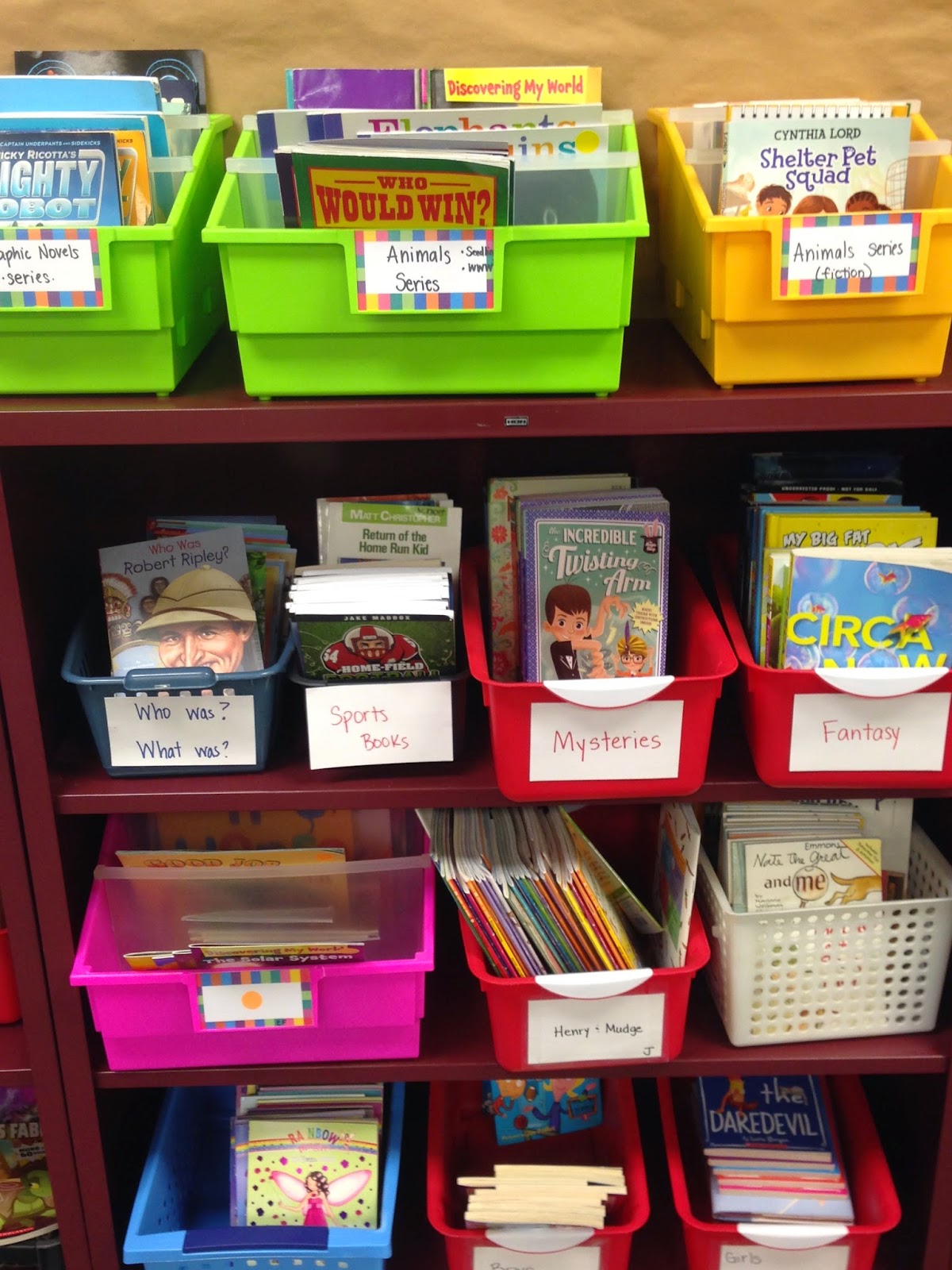
Last week I answered a Tweet posted by Michelle Nero (@litlearningzone) about how our book rooms are organized.  We started a great conversation which led to a few more inquiries of how mine is organized.  Here it is in pictures and thoughts.

I wanted to create a room that has books out in a visually appealing manner, easily organized and a place where any students could come check out books.  I work with students all over the building, and we're not always in this room.  I needed it to be well organized and self-explanatory so that way if students visit this room with an assistant, they would know how to find books without my help.  My reading students often come to me without a book identity and not feeling like they are readers.  My goal by the time they leave me is they know what they like, they've tried different genres, and they know what to do to continue their reading life.  Big goals, but I aspire to reach them with each student.  
The wonderful thing that has happened is my reading students have influenced their classmates.  Before we knew it this year, we had students all over the building wanting to come down to my room to check out books.  My reading students always get first priority, but I'm happy to let anyone check out books.  
I try to keep current with my book selection.  I purchase a lot with my own money, which is not always an option for all teachers.  I figure I read the books, my daughter reads the books, and then there are lots of school children who read them, what a value!  I get other books from Scholastic, which is a wonderful option.  I don't have students order from me since they order from their classroom teacher, but I get a few bonus points from my orders that I always turn over right away and buy more books.  
I don't have as much room as I would like, so I'm constantly weeding out books to make sure I have room.  The tired and true books stay, but kind of like the rule with throwing away clothes in my closet, if I haven't worn them/a child hasn't checked out a book in a year, it can be weeded.  I give them away to new teachers, students or book collection services.  
Students check out books by writing their name and the book title on a paper on a clipboard.  Nothing fancy.  I tried using an online book service, but I couldn't get it on the school iPad, only on my iPhone, and since I don't leave my phone in the room, it became impractical.  The kids can sign their own books out, and I can hunt them down if I need them.  Probably not the most efficient way, but it works for now.
The top shelves are my most popular books, the ones that I know the kids like to check out and find very easily.
I do have books that are leveled by a colored dot system.  These are picture books that are leveled, but grouped together in multiple levels.  For example, A-D are together since they have similar characteristics.  I continue that up through P.  Some are divided out by fiction/informational text.  I level these books for a purpose.  I service 1st-4th gr students.  While I strongly believe in choice, I also know students need accessible texts to support their growth.  Every child can check a choice book out.  My younger students who need support, also check out a book they can read on their own.  We talk about the characteristics of each colored dot bin.  We talk about books that have short sentences vs. longer sentences.  Books with just a few sentences per page vs. books that have more text than pictures.  Books that have pictures that help tell the story and words and books that have pictures that support the story but may not help figure out the words.  This way, students understand what books are right for them instead of me assigning them a level.
I really like the colorful bins that I was able to purchase this year.  They are eye appealing and the best part is there are dividers so I can section off series.  Each bin has 3 sections, so I can use 1 bin to keep 3 series organized in.  It also gives a separation for the picture books so they aren't all stuffed in the large bin.  I got them through Really Good Stuff.
Some favorite bins are the new books bins.  As I bring in new books, they go in this bin and they are frequented often!  I have a new bin that has longer chapter books and another one for transitional chapter books.
I also started a Challenge for students.  Our students in 3-4th grade can vote in the IL Bluestem Choice Awards.  The list for the 2016 vote just came out in March and students have until February to read at least 4 books from the 20 book list so they can vote.  I have bookmarks in this bin that list the books so they can keep track of what they have read.  I posted above this bin the books I own from the list that they can check out and another list of the books I have read from this list.
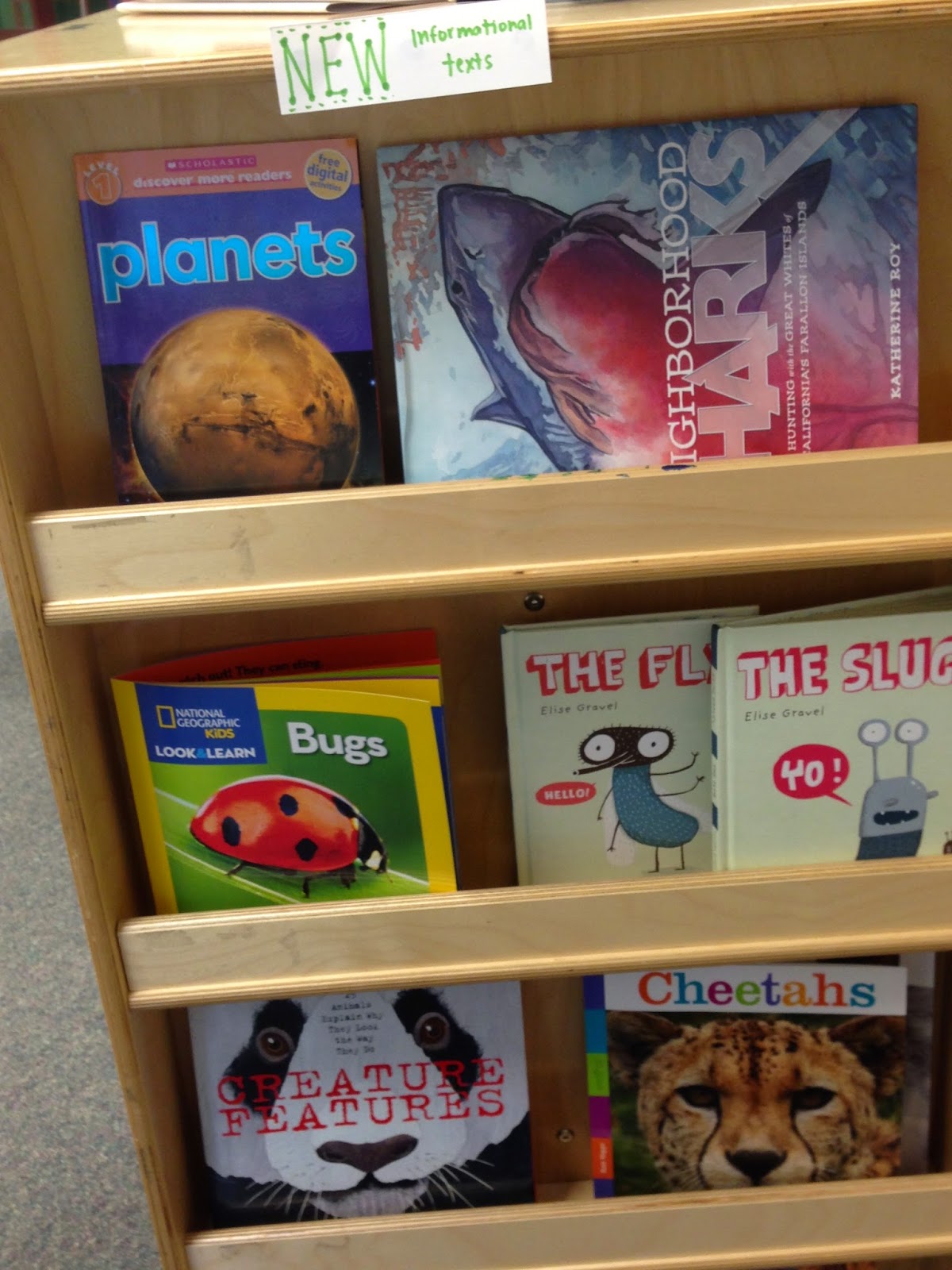
This year we received a bookshelf someone didn't want.  It has 4 sides: 2 are for display, 2 sides you can stack books.  I use them for my new picture books.  One display side is for new fiction picture books, the other for new informational text picture books.  The sides are where I rotate them out.  Anything I purchase this year goes on the shelf.  At the end of the year I will dot them and put them in the bins and start over next year!
Here are my shelves in pictures!

         
Top shelf has fantasy and realistic fiction series.  Also popular graphic novels.
2nd shelf has more graphic novels and books that have text and illustrations (Wimpy Kid, Big Nate, etc)
3rd and 4th shelves more series, most that aren't as popular.


Colored Dot bins
The yellow dot bins have an informational text bin and a fiction text bin

Top shelf has the "new" books.  Popular bins!  Also the IL Bluestem books.  I've since added lists of what they can check out and bookmarks so they can keep track what they have read.
Bottom shelves have colored dot bins.

Top shelf has the very popular Elephant and Piggie and Fly Guy collections.  Also transitional chapter books.
Middle shelves are divided by genre.

Top shelf has Animal series (Who Would Win, Seedlings series, National Geographic Kids) and animal series.
Next shelves are divided by genre.

New Fiction Picture Books on display for eager readers!

New Informational Text Picture Books


What do you do to organize your book room?  Any ideas to pass along to me?


Tuesday, April 7, 2015

SoLSC My Love/Hate Relationship with ARCs 4.07.15


Slice of Life is a weekly event hosted by Two Writing Teachers.


ARCs.  
                                                                     Advanced Reader's Copies.

I have a major love/hate relationship with them.

Love

I have itchy fingers syndrome.  Do you have that?  It's when you hear about a new book, one that may not be out for awhile.  One you can't get your fingers on for a bit.  And then your fingers start twitching.  They get itchy.  They just want to hold that book.  Happens all the time.  When I know I can't have immediate access to a book, well, it makes me want it more.

I'm not one who gets ARCs sent to me.  The majority of my current ARCs came from last year's NCTE or this year's ALA.  That was ARC heaven!  I have received them in the mail from different publishers, usually because I was lucky and I retweeted something in time!

Having an ARC and being able to tell people about the wonderful reading they have ahead of them is exciting.  Sharing book love makes my heart happy.  There is something special about passing along something new. 

I love having the newest of things.  They're shiny.  They have a special smell to them.  And if they're books, there is something to cracking a spine (well, not all the way, because I hate making that first crack in a paperback).  ARCs, even though they are paperbacks, still have that newness about them.  They make me current and way up to date!

But.... there's the flip side

Hate 
(well, not really hate.  That's a strong word.  But since we're talking love/hate relationships, I have to stick with the word.  Really it's just dislike)

Well, first of all, I really don't get that many ARCs, so it's not a huge issue.  I keep saying I want to get them, but really, I'm not so sure.

The biggest problem I have with ARCs is that so often, I hear that the author makes changes from the advanced copy to the published book.  Often they are small changes, that probably wouldn't change the overall reading experience for me.  But sometimes they are bigger changes.  That makes me feel like I need to reread the book - the published book - because I want to have read the book that everyone else is reading.  And honestly, I really don't have time for rereading.  I have nothing against it.  I've reread the Harry Potter books multiple times.  Each.  I just have so many other books already purchased, waiting for me to read.  I feel like I can't stop and reread a book.  But I want to... I read Fish in a Tree in September, but I hear that were several small changes.  I want to reread that one again, for sure.  I've held off on reading Liesl Shurtliff's Jack because I've heard, from her, there were a lot of changes.  I really need someone to come up with a way to make sleep unnecessary.  Because there would be a lot more reading time in my life!

The other problem I have, and it's not so much a problem with the ARC, it's that I have so many books to read!  I'm a book connoisseur.  I purchase books endlessly.  I pre-order books.  I can't go in a bookstore without buying books.  I figure they are well worth the money spent.  Each book is read at least twice - once by me, once by my daughter.  Sometimes three times if I pass it along to my husband (he's getting The Crossover next).  Some go to my nieces.  Probably 90% of my books go into my classroom.  I'm a reading specialist and I pass my books on to my students, but then they pass them on to their classmates.  You should see the amount of kids that come to my room to check out books - I run library #2 at school!  So I feel like the amount of money I'm spending on a book, really goes the distance.  But I have so many, I have a hard time juggling ARC reading vs. reading the books I have and getting them to the kids.  If I really love an ARC, I buy a copy.  Publishers don't give out ARCs for classroom copies.  They are depending on us to book talk those books and then get people buying the published books.  So it's hard to always read an ARC when I have a book that is waiting for a child to read.

What are your feelings on ARCs.  Do you have itchy fingers syndrome?  What ARC are you dying to get your hands on (for me it's Katherine Applegate's Crenshaw, I don't think it's out yet, but once it is, I'll have to sit on my fingers!)