Monday, March 14, 2016

It's Monday! What Are You Reading? 3.14.16

IMWAYR 2015 logo

This weekly post comes from Jen at Teach Mentor Texts and Kellee and Ricki at Unleashing Readers.  It's a great source to find new books to use with your students.

I took a little break last week as we were on vacation.  Lucky me, vacation brought nerdy bloggers together - I had the chance to visit with our "Unleashing Readers" friend, Kellee Moye!  Love meeting nerdy friends in real life!  

Vacation always leads to some extra reading time.  Sharing some great new chapter books today and my weekend of binge reading picture books!

Last Two Weeks Adventures

Looking for some great nonfiction picture books?  Check out This is the Earth here which would make a perfect Earth Day book.  If you teach K-2, you want to make sure to add this book about community helpers to your book shelves.  Loved it!

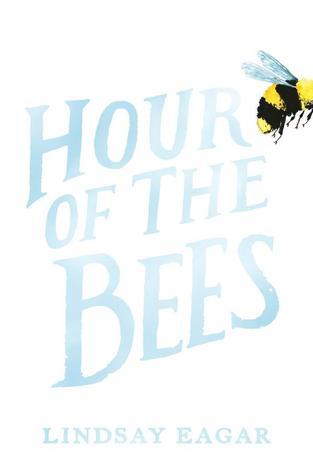
I read this glorious book and immediately wanted to reread.  Be sure to check out Hour of the Bees.

Did you follow along on the Normal Norman blog tour?  Here are some ideas on using this wonderful book in your reading or writing block time!

Now that we're more than halfway through the school year, it's a great time to have students look back on the readerly lives.  Here are some books you might use when talking about it!

Picture Books

Emma and Julia Love Ballet
Emma and Julia Love Ballet by Barbara McClintock
3/5 stars
A comparison between a young child, Emma, and a professional ballerina, Julia, and how similar they are.  Both have a passion for ballet and work hard at what they love.  I could see young ballerinas loving this story but I think you could also use it to talk to kids about doing what they love and chasing a dream.

Puddle
Puddle by Hyewon Yum
4/5 stars
Sweet picture book that young readers will really enjoy.  A mother-son story about the power of imagination and making it come to life!

Lionheart
Lionheart by Richard Collingridge
4/5 stars
The illustrations are gorgeous.
It's a sweet story about a boy who needs to be brave to fight a monster.  His stuffed animal comes to life to show him how to use his friends and find his voice to roar!
Reminiscent of Where the Wild Things Are and "Narnia", I think young readers will enjoy this one.  The theme is a good one, maybe a bit weak in the telling, but one you could use as part of a collection of books to teach theme.

Get a Hit, Mo!
Get a Hit, Mo! by David Adler
3/5 stars
Mo, our surprise Geisel winner, is back and this time it's baseball season.  Mo is still too small, too young to be the star on his baseball team.  This time, it's pure luck that helps him win the game for his team.

Dylan the Villain
Dylan the Villain by K.G. Campbell
3/5 stars
I do love villain stories!  This was a cute one, will be fun to read with some villainous laughter!  Liked the open ending.

Quick, Little Monkey!
Quick, Little Monkey by Sarah L. Thomson
4/5 stars
Loved this picture book!  Perfect for young readers.  Little Monkey learns to heed the life lessons from her Papa when she finds herself in new territory.  Great author's note giving real information about the animals seen in this book.

Ideas Are All Around
Ideas Are All Around by Philip Stead
4/5 stars
I could see teachers using this in writer's workshop - how to get ideas all around you and turn those small moments into a story.


Transitional Chapter Books

Product Details
Piper Green and the Fairy Tree:  The Sea Pony by Ellen Potter
4/5 stars
This series is so perfect for fans of Junie B., Clementine and Judy Moody.  I hope Piper Green gets as much love as they do!
In this third installment, Piper gets a special whistle necklace from the Fairy Tree.  As in all gifts from the Fairy Tree, you never know when they will come in handy, but like always, this special necklace helps out in unforeseen ways!

Middle Grade

Rookie of the Year (Rip and Red, #2)
Rookie of the Year by Phil Bildner
4/5 stars
If you haven't already read the first book in the Rip and Red series, A Whole New Ballgame, I highly recommend you get to it soon.  This series is so fun for kids and for teachers.  Teachers will want to be Mr. Acevedo.  Teachers will see that this series is perfect for read aloud!  Kids will love the characters in the story and relate to the problems the kids come across.  Make sure you put this second book on your radar in July.

Young Adult

Salt to the Sea
Salt to the Sea by Ruta Sepetys
5/5 stars
I have loved Sepetys' other two young adult books and this one was just as amazing.  It took a little bit to get into since the story is told in 4 different voices.  Once I had the characters straight and I knew what was going on in the story, I was sucked in and just wanted to keep reading.  I love getting the different perspectives and seeing this time in history from four different views.  Some characters I really liked and some I loved to hate.  
It's after reading books like this that tell me a part about history that I might not have ever really known about that always amazes me that there is so much about this world I don't know.

Currently Reading
Red Queen (Red Queen, #1)
Red Queen by Victoria Aveyard
This is my February #mustreadin2016.  I know, I'm a bit late.  But so glad to be getting to this one!  If you enjoy Marie Lu's books, this is a don't miss!

Happy Reading!


Friday, March 11, 2016

Spotlight Friday - The Readerly Life 3.11.16


Time to get ready for the weekend!
Kick up your feet and find a good place to read.
Sharing #booklove for your classroom or library.
Spotlighting a book or two because these books deserve the spotlight!


Very early on in the year, many of us take the time to talk to students about a Readerly Life. Now that the year is half over, it may be time to go back, revisit goals, modify goals, make new ones, reevaluate and think anew.  Here are some great books you may choose to use when talking about a Readerly Life!

Surf's Up
Surf's Up
by Kwame Alexander
Perfect to show what it's like to fall into a book!

Library Day
Library Day
by Anne Rockwell
Sweet book about a boy's first trip to the library.  Lots of library details are noted in the illustrations as well as the text.

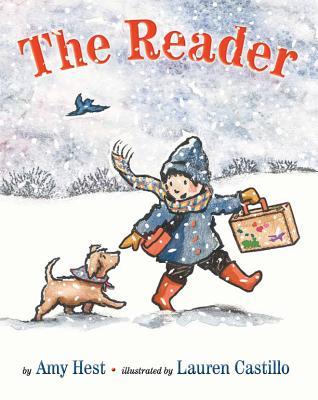
The Reader
The Reader
by Amy Hest
Illustrated by one of my favorites, Lauren Castillo, I love how our young character always has his book with him and protects it from the elements.

How to Read a Story
How to Read a Story
by Kate Messner
Wise advice on every page!

other favorites:

Read All About It!
Read All About It!
by Laura and Jenna Bush

Please, Louise
Please, Louise
by Toni and Slade Morrison

Library Mouse (Library Mouse #1)
Library Mouse
by Daniel Kirk

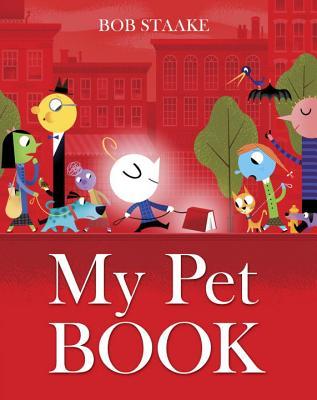
My Pet Book
My Pet Book
by Bob Staake

The Snatchabook
The Snatchabook
by Helen Docherty

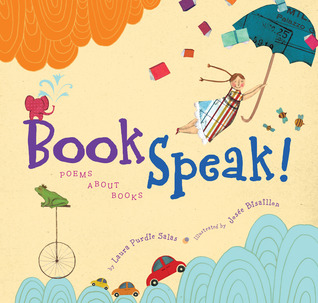
BookSpeak!: Poems about Books
BookSpeak! 
by Laurie Purdie Salas

Please Bury Me in the Library
Please Bury Me in the Library 
by J. Patrick Lewis


Come back next week and get some ideas of picture books you can use to show a Writer's Life!

Wednesday, March 9, 2016

Nonfiction Picture Book Wednesday - Community Helpers - 3.09.16

Every Wednesday I join Alyson Beecher from kidlitfrenzy and other
kidlit bloggers to share wonderful nonfiction picture books.
The intention of today's blog is to give educational professionals
new nonfiction reading material and ideas to use 
with students to promote a love of reading nonfiction materials.


Image result for whose hands are these
Whose Hands Are These? A Community Helper Guessing Book
written by Miranda Paul
illustrated by Luciana Navarro Powell
published by Millbrook Press

Miranda Paul has such a clever way with words and making nonfiction enjoyable!  With Water is Water, her lyrical verses that subtly give information about the water cycle, with additional information in the back matter, was such an enjoyable 2015 book.  In her newest, Whose Hands Are These? she makes another nonfiction book that will be loved by young readers.  This is a fantastic book for primary classrooms and libraries.

A clever riddle is on the right side of the page.  The riddle is written in rhyme which will help young readers when making a guess of the occupation.  On the back side of the page is the answer.  I love the diverse characters and occupations Paul has chosen.  With community helpers like farmers, police officers, scientists, potters, news reporters, architects, and referees, young children are exposed to current community helpers that are interesting and varied.  I also appreciate the diverse characters.  There are male and female workers shown, which is especially important on some of the pages with occupations that can be stereotypical, such as mechanic, architect, police officer, and even teachers.  There is also different ethnic backgrounds shown.  Even disabilities are depicted - on the potter page it looks like the character has either a hearing aid or cochlear implant.  I like that the book stays true to its audience and includes a child on many of the pages.  The end pages also have additional information about each occupation.

With beautiful illustrations from Luciana Navarro Powell, she brings to life each vocation and adds little details that could further classroom discussions.  I love the inclusion of hands throughout the book.   On each riddle page, instead of showing the community helper, you see the worker's hands doing a variety of things that are including in their job.  There are also tools that are pertinent to that job - adding this to a discussion is a wonderful way to expand vocabulary!

Image result for whose hands are these                Image result for whose hands are these

The book trailer is a must-see!


This is a wonderful book to add to classrooms and libraries.  I hope you found a reason to pick it up!

Friday, March 4, 2016

Spotlight Friday - Normal Norman 3.04.16


Time to get ready for the weekend!
Kick up your feet and find a good place to read.
Sharing #booklove for your classroom or library.
Spotlighting a book or two because these books deserve the spotlight!


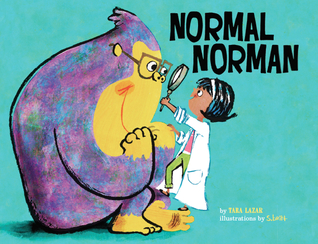
Normal Norman
Normal Norman
written by Tara Lazar
illustrated by S.britt
published by Sterling Children's Books

I love that moment when you read a book and your heart gets a little bit bigger because you know you have found a book that you can't wait to share.  Normal Norman is one of those books.  Tara Lazar has crafted a timeless story, and one that is so important to share with young readers today.

Ultimately asking, what is normal, a junior scientist has found a completely "normal" gorilla to share with us.  Of course, within pages, we learn that Norman the gorilla is not scientifically considered normal.  And, is that ok?  Not at first with our young scientist.  The more "abnormal" Norman shows us to be, the more frustrated our young scientist becomes. But, of course, what is normal?  Is it ok to be unique?  Who decides what is normal?  All great questions to ask and discuss and share.

Mentor text for reading: character development and theme
  • I love the change in the character's thinking in this book.  Find points where you see the junior scientist's thinking changing. 
  • Using sticky notes, find places where the author showed theme - but look at it from both sides - how did Norman show what was normal, and how did the junior scientist argue what was normal?

Mentor text for writing:  opinion writing and POV
  • Pick a side, any side!  Is Norman normal?  Come up with your points and write and debate!  What a discussion!
  • Tara chose to have the junior scientist, the narrator, talk directly to the readers.  How does this choice work?

I also had the opportunity to ask Tara some questions about her book:


1.  This book clearly takes a look at what people perceive as being "normal".  What sparked the idea for this book and how did a gorilla get involved?


The story began with a name only: Normal Norman. And I knew he had to be ABNORMAL. He had to do the opposite of what the reader expected. Somehow it felt right to introduce him via a Junior Scientist, so I just went with it. 

The oddball thing is that I didn't know what kind of animal Norman was. And I thought it was a super opportunity for an illustrator to figure it out! If I were an illustrator, I'd want that job! 

S.britt came up with a few different versions of Norman, but just looking at them, Meredith (my editor) and I didn't think he quite hit upon it. Then he drew a purple orangutan with nerdy glasses and we KNEW IT. We knew the way you know about a good melon.


2.  Our 2nd graders were so fortunate to Skype with you this year.  It was at this Skype visit, we learned that you have some great acting abilities, at the very least, some great accents.  When you read this out loud, how does Norman sound?  How about the junior scientist?


I'm embarrassed to say I haven't hit upon Norman's voice yet. Whatever I've tried hasn't sounded right. I may go with a refined English accent. That may work. The Junior Scientist sounds too much like Little Red Gliding Hood right now. I need to watch some old school cartoons and work on my voices.


3.  You've inspired so many with your PiBoIdMo idea.  Can you tell us about one of your favorite moments that has come from this?


Every time someone contacts me with a "success story"--a PiBoIdMo idea that has blossomed into a manuscript that won an award, an agent or a contract! That's just the best. It's happened so many times now that I've lost count!


4.  This book has a timeless theme and I can see this book being used as a mentor text in generations to come.  What is something you're hoping that a reader doesn't miss in this book?


I hope they don't miss that it's not only good to be different, but it's essential. The world would not function if everyone wanted to behave normally. There would be no new inventions, no pioneers, no one taking risks. There would be no failure, and therefore, no success. Weirdos rule. Always remember that.

5.  Tell us about the moment when you saw Norman for the first time as illustrated by Stephan Britt.


OH MY GOOOOOOOOOOOSH!!!!!!! THAT'S HIM!

Please note that is a prolonged short-vowel "gosh" and not a long-vowel "goosh" like "Koosh."

It is amazing to see something you created come to life. It cannot be adequately explained. It's a mixture of pride, wonder and ludicrous giddiness. It's a bit surreal. You can't believe something materialized out of thin air. From my head to a kid's bedtime ritual. Weird, man! Groovy!

Thank you, Tara, for taking the time to answer questions.


Everyone, please run out to your local bookstore or library and get your hands on a copy of Normal Norman.  You'll be so glad you did!

Would you like to win a copy of Normal Norman?  Find my tweet (@knott_michele) about the giveaway and retweet it by 7pmEST on March 6th for a chance to win!

Be sure to visit all the stops on the Normal Norman blog tour!


Thursday, March 3, 2016

review of Hour of the Bees 3.03.16

Stories connect us and those stories that connect us to our roots are even more powerful.

I have so many memories of time spent with my grandparents as I was growing up.  I had a set of grandparents that I saw frequently.  I have early memories of staying over night for days at a time.  Playing in the basement.  Time spent eating dinner at the big kitchen table.  Getting to go on special excursions.  Then when they moved to Arizona it would be extended trips that brought more memories.  My other set of grandparents didn't live nearby but as a result, when I would go visit it would always be for an extended time.  So while not as often, the longer visits left plenty of time for cultivating memories.


Hour of the Bees
Hour of the Bees
by Lindsay Eagar
published by Candlewick


While I read Hour of the Bees, it was these memories that came forward and reminded me how valuable time can be.

Hour of the Bees is a story about family.  Carol, our main character, has to leave her hometown of Albuquerque and live at her grandfather's ranch in the drought-ridden New Mexico desert for the summer.  They are going to the ranch to fix it up and sell.  They need to move her grandfather Serge, who she has never met, into a home as a result of his progressing dementia.  Carol's relationship with her grandpa Serge and how it changes over time is the heart of this story.  But different than your regular grandfather/granddaughter bonding story.  Their story revolves around the telling of a story, one that helps explain her roots.  It's a story that is told over time, throughout the book.  We see Carol's view change as she hears more of this magical story.  As we get glimpses of the past and the implications on what is happening in the present, we are drawn more into this family.  By the time I was nearing the end of the book, I closed it, not wanting it to end, needing it to slow down.  This magical story inside the story is beautifully written and one you soon won't forget.

This book is also about life and death.  Serge's story centers around bees, a lake, a seed and one very special tree.  All of these things, as they live, symbolize life - breathing and growing.  It's when we take these things away, that we experience death.  I think this magical story that we read is going to be an amazing topic for readers to talk about and write about.


"She didn't think; she accepted."
pg. 357 from the uncorrected copy

As I read this book I wrote down so many thoughts.  I could probably fill up a week of blog posts of my thinking.  Much of what I have to say, I would love to talk about.  But you need to explore this book yourself.  Find time to get lost in this story.  It is brilliant.  But full warning, it may take time to get over this book and start your next one.

Wednesday, March 2, 2016

Nonfiction Picture Book Wednesday - This is the Earth 3.02.16


Every Wednesday I join Alyson Beecher from kidlitfrenzy and other
kidlit bloggers to share wonderful nonfiction picture books.
The intention of today's blog is to give educational professionals
new nonfiction reading material and ideas to use 
with students to promote a love of reading nonfiction materials.


"...together we live on this Earth that we share."
from...

Product Details
This Is the Earth
written by Diane Z. Shore and Jessica Alexander
illustrated by Wendall Minor

Whether you celebrate Earth Day in April or every day, this is a wonderful book to share.

The organization of the book is fantastic.  It starts out by showing the natural part of our land.  It shows animals that live on Earth - on the land, in the oceans and in the sky.  The text of the book transitions smoothly into the next section where it shows the history of the United States.  Depicting different regions, such as the southwest and the plains, it goes on to show advancements Americans made with trains, steamers transporting goods, and the first flight, going right into present time, showing skyscrapers, cities and busy commuters.  However, going into the present time, we also see that all of our advancements have made an impact on our Earth.  The text and illustrations show landfills, pipes dumping waste into the sea, smoke in the sky, pollution, tearing down natural resources and global warming.  Finally, the author and illustrator talk about ways we could save the environment by giving back, protecting the land and animals and using reusable goods.

At the back of the book there is an important note from the illustrator.  He talks about the significance of Earth Day.  It comes from when Apollo 8 astronauts took a picture of Earth from space, people started realizing how fragile Earth really is.  From this photo, the idea of Earth Day was eventually sprung.  An illustration of the photograph is included as the end pages of the book. 

This is a great book to add to your library or classroom collection.  Share it with young readers!


* please note I'm stretching the genre of the text just a little bit - I believe it's classified as fiction, but with wonderful real facts, I know it's a great book to inspire conversations about what is happening to our Earth.