Tuesday, November 1, 2022

New Kids and Underdogs - a review 11.01.22

"We all need each other.  Because we are all sort of one, but also sort of not one.  Basically, we are a pack...of roots." 
                    - New Kids and Underdogs by Margaret Finnegan pg. 212


New Kids and Underdogs by Margaret Finnegan
New Kids and Underdogs
by Margaret Finnegan
published by Atheneum Books


Are you looking for a book that will grip your readers?  Look no further!  This heartprint story and the unforgettable characters will keep readers turning the page and leave feeling a little smarter and like they've made another friend.

Fifth-grader Robyn is the perpetual new kid.   In fact, she's gone through being new at so many schools, she's now made up some rules for herself.  Rules that will perhaps help her avoid previous mistakes and help her succeed at her new school in California.  Robyn wants so badly to succeed because this school, finally, is supposed to be the school that she is going to stay at.  Being new and fitting in could be the book all alone.  But, every plot needs to have foils.

Foil #1:  Dogs.  Robyn has two Jack Russell terrier mixed rescue dogs: Fudge and Sundae.  The love and friendship between the dogs and Robyn is a beautiful thing.  The dogs are so loving, and are a wonderful unit between them and Robyn.  Each dog has their own challenges.  They were both rescued from a place that created trauma and an environment that did not allow either dog to thrive.  Fudge is deaf and partially blind.  He relies on Sundae, especially when in an unfamiliar environment.  Sundae suffers from anxiety and being with Fudge helps calm that fear.  Both challenges bring up the subject of living - and thriving - with a disability.  Robyn understands her dogs challenges, but also comes to learn more about the range of disabilities and challenges of her peers.  The subject of disabilities is well done and author Margaret Finnegan brings up great viewpoints.  She helps readers understand, through the characters, that they are more than their disability.  It's part of who they are, but there are many other parts that make up the person/animal.

Foil #2:  Agility training for dogs.  Right away, Robyn comes across an agility class being held nearby for dogs.  Both her and Sundae are entranced by what they see.  Robyn looks into it, but the instructor does not think her dogs can do it based on one thing: their disabilities.  But it's the instructor's grandson, Nestor - Robyn's classmate - who sees more than the dogs' disabilities.  Nestor starts training the dogs himself and instead of it being called agility class, it's ability class.  I love the twist that makes all the difference for the dogs and Robyn.  It's through these new classes that Robyn learns more about herself and makes her go back through those new kid rules she had established.  One of my favorite quotes, "Dog training wasn't a way to impose a person's will upon a dog.  It was about learning to communicate with another species and learning to listen as that species communicated with you." - pg. 234.

All of these things come together to make a wonderful story.  I loved so many lines that made me pause and think about them.  Lots of great social-emotional lessons and things to talk about when thinking about people - the parts you see on the outside and what you don't see on the inside.  This book makes a great read aloud and is easy to book talk.  No doubt it will be a favorite among readers!  Be sure to send readers to Margaret Finnegan's website, she has lots of resources and linked below are tips to train dogs!

More praise for New Kids and Underdogs:

“A thoughtful story about learning to look beneath the surface and be a better friend.” —Kirkus


A Junior Library Guild Selection


Margaret Finnegan is the author of We Could Be Heroes and Susie B. Won’t Back Down, both Junior Library Guild Selections. Her other works have appeared in FamilyFun Magazine, the Los Angeles Times, Salon, and other publications. She lives in South Pasadena, California, where she enjoys spending time with her family, walking her dog, and baking really good chocolate cakes. To learn more, and to download free discussion guides, visit MargaretFinnegan.com.

Twitter: @FinneganBegin

Instagram: @finneganbegin


Just like the kids in New Kids & Underdogs, you can ability train your dog! Check out the fun tips here!

Thank you to Barbara at Blue Slip Media for the review copy.

Instagram: @blue_slip_media

Facebook: Blue Slip Media

Wednesday, October 19, 2022

A Beginner's Guide to Being Human - a review 10.19.22

I'm just going to start with this - EVERYONE needs this book.  ALL libraries, ALL classrooms, ALL humans.  Because, honestly.... it seems like many of us have forgotten what humanity is.  Or what is should be.

A Beginner's Guide to Being Human by Matt Forrest Esenwine
A Beginner's Guide to Being Human
written by Matt Forrest Esenwine
illustrated by André Geolin
published by Beaming Books


Author Matt Esenwine reminds us of what humanity should be.  It's families.  Of all shapes and sizes and colors and numbers.  I love that he even says that you don't have to be related to be considered family.


Esenwine goes over empathy, compassion, and most importantly, kindness.  Through the text and illustrations, readers see both the good and not-so-good examples of humans showing these things.  Because, after all, as Esenwine says, humans do make mistakes too.  


Follow along with the pro-tips of how a little bit of kindness or compassion or empathy can go a long way!  And while these tips may seem to be something we all know, it's a good reminder for all readers to practice them in the future!

And at the end, what's really important is the love we can have for one another.  What a perfect reminder.

I was fortunate to be able to ask author Matt Esenwine a couple of questions:

Q:  How did the idea of this one come about?

A:  It was a really challenging book to write, not because it was difficult but because it was wasn't even my idea, ha! It's actually the first time I’ve ever written and published a book specifically requested by an editor. I had submitted a completely different manuscript with a similar title to Naomi Krueger at Beaming Books, my editor for ONCE UPON ANOTHER TIME and although she didn't feel it was a good fit for her list, she really liked it and told me about an idea she’d had for a different book, written in the same sort of style but focusing on emotions and feelings. She said we could title it A BEGINNER'S GUIDE TO BEING HUMAN and asked if I'd be interested in writing it, knowing there was no guarantee she’d accept the new manuscript. Fortunately, she liked it!

Q:  You talk about this book being creative nonfiction.  Tell us more about that!

A:  Creative nonfiction is a really cool genre that has been gaining popularity the past few years. It presents elements of nonfiction - facts, information, etc. - by using creative devices like narrative, dialogue, lyricism/poetry, etc. Examples of creative nonfiction are Lita Judge's WISDOM OF TREES, Joyce Sidman's DARK EMPEROR, and Melissa Stewart's FEATHERS NOT JUST FOR FLYING. 

Thanks, Matt!

This book should be shared at the beginning of the year, and probably at the middle and end, as well!  The simple text doesn't preach, doesn't feel like a lesson, but gives us a little check of how we should be taking life day-by-day.  The gorgeous illustrations by  are authentic and diverse.  

More about author Matt Esenwine:

Matt Forrest Esenwine spent a good part of his life writing and publishing poetry for various national journals and anthologies like the Donald Hall tribute, Except for Love (Encircle, 2019). Then his debut picture book, Flashlight Night (Astra Young Readers, 2017), received a Kirkus starred review and was included in Encyclopedia Brittanica’s list of “11 Children’s Books That Inspire Imagination!”

Matt now has nearly a dozen books to his credit including Once Upon Another Time (Beaming Books, 2021), co-authored with Charles “Father Goose” Ghigna, and I Am Today (POW! Kids Bokos, 2022). His children’s poetry can be found in anthologies like The National Geographic Book of Nature Poetry (National Geographic Children’s Books, 2015) and Construction People (Wordsong, 2020). Connect with Matt and order personally-signed books here.

I know you'll be wanting to get your hands on a copy of this book!  Author Matt Esenwine and publisher Beaming Books have donated a copy for a blog reader!  Winner will be selected on Wednesday, October 26th.

Wednesday, October 12, 2022

Ice Cycles - a review 10.12.22

My least favorite season is coming - winter.  For many others, they are celebrating all that comes with winter - the cold temps, snow, and the outdoor activities that involve snow.  Snow looks pretty in a picture.  And the ice that accompanies it can have beautiful designs and swirls.  Have you ever thought about that ice you see in the winter?  What about the ice that forms in bodies of water?  Maria Gianferrari helps us dig into ice a little further in her new book....

Ice Cycle by Maria Gianferrari
Ice Cycle: Poems About the Life of Ice
written by Maria Gianferrari
illustrated by Jieting Chen
published by Millbrook Press


I love that Maria helps us think about ice in a lyrical and alive way.  She talks about the way ice moves, forms, and makes noises.  She digs into how ice changes and that it doesn't stay the same.  And all along, we feel the sense of movement and change with her lyrical poems.  While young readers are learning about the ice in their world, they are doing so through poems that make the words dance and stretch and move through Maria's beautiful writing.

I am a big fan of Maria's writing.  Whether through poems or prose, she brings nonfiction to life.  I asked Maria about this, and I think her response is something to share with young readers to make them think more about their own writing and writing processes.  I'll let Maria take over now!

******************************************************************************

Tips for Translating STEM Topics into Poetic Texts

I’m delighted to be back here at Mrs. Knott’s Book Nook, a favorite and go-to blog for book recommendations. Thanks for having me, Michele!

Today I’ll be talking about translating STEM and scientific research into lyrical writing. For me, science and poetry go hand-in-hand and are complementary. I love how poetry can distill and encapsulate images and how scientific language and vocabulary can also be quite poetic in nature.

Research & Pre-writing: 

During my research process, which often includes some kind of field research, like walking in the woods, taking photos of things that I observe, or noting other sensory details like smells and sounds and textures, I take notes to collect my thoughts and impressions by hand in a notebook. Writing by hand is slower, and it makes me feel more of a connection to the material that I’m working with, which helps me to reflect. Then I type up and print my notes, highlighting interesting vocabulary, images and phrases to see what patterns emerge. Next, I focus freewrite to explore my thoughts on the topic including voice, structure and theme.

Sensory Lists: 

Make lists that include your sensory observations. What interesting visuals emerge, and how can you describe them in a fresh and fun way? I try to paint a picture in words. ICE CYCLE is dedicated to my editor at Lerner, Carol Hinz, whose gorgeous photos of feathery frost like this one on Instagram first inspired the idea for the book. 

I was wowed by this photo and the visually stunning fern-like and feathery frost crystal formations, and highlighted those shapes in my poems about frost.


photo credit, Carol Hinz

And this intricate needle ice I found in my yard.


photo credit me ☺


Seek out sounds. I was amazed to discover that ice has many evocative and poetic-sounding names. As I mentioned above, I think poetry and science are complementary, and that scientific vocabulary is often poetic in and of itself. I loved the sounds of these sea ice names: hummocks and bummocks and shuga.


It doesn’t get more magical and evocative than pancake ice and dragon-scale ice, does it? 


photo credit Guy Williams


Have you heard of a brinicle? I hadn’t, before researching for this book. What does that evoke for you? I loved the sound of it, and watching videos of them pluming and blooming as they spread underwater. 


Watch a brinicle form here: https://www.youtube.com/watch?v=lAupJzH31tc


What other senses can you incorporate into your manuscript. Taste? Texture? Scent? Is there a unique way to bring your lists together?


STEM Strands: 


Part of the process of translating the stuff of STEM into lyrical poetic writing includes weaving in scientific facts, processes and vocabulary. For example, in HAWK RISING, I described the red-tailed hawk’s flight as “kiting.” Without even seeing Brian’s gorgeous art, one can easily visualize what’s happening as the hawk hovers in place. It’s scientifically accurate as well as poetic. 


In WHOO-KU HAIKU, the Great horned owl mother, “mantles.” Can you picture a cloak or a cape? “Mantling” is the act of a bird spreading out its wings when feeling threatened to appear bigger, or to protect something (in the book’s case, her eggs). What about “pipping?” Doesn’t it sound like chipping, delicate and lovely? It’s onomatopoeic—and the sound and act of a hatchling chipping out of its shell with its egg tooth. Using these kinds of scientific vocabulary help make a text feel authentic.


Vivid Verbs:  

Vivid verbs are a writer’s best friend for all kinds of writing! They paint pictures, evoke emotions, store sounds, and the sound of those verbs is crucial when writing lyrically. There is nothing that’s quite so effective and evocative as a verb that can create an image as well as a feeling through its flowing and sonorous syllables. 

I love the sounds and images and movement in the frost section of ICE CYCLE, and had fun morphing nouns into verbs. It begins, “Frost ferns,” which evokes shape and flow with the repetition of the fricative “f” and liquid “r” sounds. 


As that poem continues, I tried to evoke the visual pattern as well as movement incorporated into the shapes and textures of frost using assonance and rhyme: frost fronds “curling” and “unfurling” as well as “binding” and “unwinding” feathery spines.  Verbs such as fanning, forking and flowering flow with alliterative “f” sounds, and also evoke both shape and energy and dynamism because they are “ing,” in process.


There is also rhythm and flow in the various ways ice moves: floes flow, riding, gliding, drifting, shifting, because ice is in flux, depending upon the weather conditions.


Be Playful:


In the “Ice Plays” section of ICE CYCLE, I used vivid and active verbs and sound to highlight the unusual visuals, beautifully depicted in Jieting’s fabulous art: Cat ice whorls/Swirl and twirl. Pancake ice stacks/Smack and crack, etc. 


Word play is fun! This spread ends with an ice tongue that licks and ice foot that kicks. 


I also literally played around with sound and used vivid, loud and onomatopoeic sounding verbs in “Ice Speaks,” as well as alliteration, assonance and consonance to emphasize the aural nature of ice.


Voice and Structure: 

How do you find the right voice and structure for your project? Will it be narrative in nature, or more expository? Sometimes I know from the beginning what the structure will be, as in the case of WHOO-KU HAIKU. It’s one of the rare cases when I knew the title first. It evolved as a series of lyrical vignettes and narrative haiku poems within the general seasonal Great horned owl life cycle from nesting, to egg laying; from hatching to fledging. 

Time and seasons prove to be logical, circular and grounding structures for translating STEM into lyrical language. As I mentioned above, WHOO-KU HAIKU as well as BOBCAT PROWLING have a winter to fall/spring life cycle seasonal structure, while both COYOTE MOON and HAWK RISING have circular nocturnal/diurnal structures. 

The subtitle of ICE CYCLE, POEMS ABOUT THE LIFE OF ICE reveals its circular structure: ice is born, or formed due to dropping temperatures, and dies when temperatures rise. But it’s again re-born as temperatures plummet again—the ice cycle-life cycle. I used headings for each section and played with the verbs there as a hint of what’s to come in the poems. Ice grows, flows (and floes) goes, plays, speaks, sprouts and ages.

One of the best ways to figure out structure is to read and study a variety of mentor texts to see how other kidlit creators organized their material. Be sure to check out Sibert-honor winning author and science writer Melissa Stewart’s blog, “Celebrate Nonfiction,” where you can learn about all kinds of narrative and expository approaches, text structures and features, voice, and more.

Read Aloud:

If you write picture books, reading your manuscript aloud is key. You can hear where the language is awkward, or faltering. As you revise, pay attention to your words. Are you being as economical as possible? Get out your poetry toolbox and explore image, word choice, figurative language, line breaks, rhythm and rhyme. You might want to re-examine your lists—how can you make your words sing?

Poetry’s imagistic nature helps to distill language to its most essential elements, which is perfect for both STEM topics and picture books.

Experiment:

As with science, translating STEM content into lyrical writing (and all writing) involves experimentation, and play, trust and letting go—not being wedded to our original drafts so that we can literally re-envision what we’re writing. Failure and rejection are part of the discovery process. 

I am fascinated by mushrooms and fungi, and my original manuscript called MARVELOUS MUSHROOMS was a concept book that had lyrical moments, but things weren’t coming together on paper quite in the way I was envisioning it in my head. Luckily it still sparked the interest of editor extraordinaire Andrea Welch of Beach Lane who requested a revision. After a great conversation and many, many revisions, I took a new approach favoring vivid verbs to blend science and poetry and wonder and it evolved to be FUNGI GROW, with swirling and gorgeous art by Diana Sudyka! I wrote the book with Diana’s illustrations in mind, so I was thrilled when she signed on to illustrate! I can’t wait to share our book with the world next fall. 

What STEM things delight you and make you wonder? Let your curiosity and awe lead you along the road of research. And then write lists, find patterns, listen to your inner voice and experiment, mix and meld and blend to find the ways that fuse science and poetry into your own unique work of wonder.

******************************************************************************

Thank you so much, Maria, for stopping by and sharing your writing expertise with us!  

More about author Maria Gianferrari:
Maria Gianferrari thinks ice is nice. After seeing editor Carol Hinz’s feathery frost photos on Instagram, she was inspired to find out more. During her research, Maria was amazed by all the diverse kinds of ice that exist, and this book was born. Her favorite form is pancake ice. Maria lives in Massachusetts with her family, where winters usually bring ice and snow. You can learn more about Maria at her brand new website, mariagianferrari.com.


I bet after reading that you want your own copy of this gorgeous book!  Maria and publisher Millbrook Press, have generously donated a copy for a reader.  Winner will be selected on Wednesday, Oct. 19th!


Wednesday, September 21, 2022

Annette Feels Free - a review 9.21.22

A woman who championed women's rights, who had a disability and said "I can do this anyway", and was a swimmer?  Annette Kellerman is definitely a woman I wanted to know more about!


Annette Feels Free:
The True Story of Annette Kellerman, World-Class
Swimmer, Fashion Pioneer, and Real-Life Mermaid
by Katie Mazeika
published by Beach Lane Books


Annette was a fierce and joyful young girl, but after an illness, she suffered muscle loss in her legs and needed to wear braces for support.  Feeling constricted left Annette feeling quiet and sad and she wasn't the happy girl from before.  It was her father's idea to bring her into the water and see what she can do.  It was there that her freedom to move returned.  Annette could dance, kick, and move about in the water and it brought joy back into her life.  As she continued to grow, she found new ways to show her artistry in the water by putting on water dance shows, and ways to show her athleticism by swimming - and winning - in swim races across her homeland of Australia.  But there was one thing holding her back - what she had to wear in the water.  Annette was swimming during a time when women not only had to be covered in their attire, but it was also appropriate for their swim attire to be loose and flowy.  Hard to win when your material is causing a lot of drag!  Annette solved her own problem by creating her own swim attire, more similar to what a man would wear, but that was not ok with law enforcement!  Annette pleaded her case in court, and won!  Not only a pioneer for a women's right to wear appropriate swimwear, but also a pioneer of sport.  From competitive swimming to the sport now known as artistic swimming, Annette Kellerman lead the way!


Too often I hear people saying how "inspiring" people with disabilities are.  I've heard from many disabled athletes, including my own, who hate being described as that.  From what I understand, it makes them feel that their accomplishments are only looked at as inspiring because of their disability.  I think creator Katie Mazeika has done a wonderful job showcasing Annette's amazing accomplishments first, with a smaller note of how they came about.


I really love how Annette was described in the backmatter as, "a woman who pushed boundaries and advanced women's rights.  And we can all thank Annette for the freedom of wearing what we feel best in at the beach."  In a time when we question the rules, who makes them, who benefits from them, here is a great story of the person who helped women to the place we are now.


More accolades for Annette Feels Free:


A Junior Library  Guild Selection


“Annette’s legacy in competitive, artistic, and recreational swimming is undeniable, and Mazeika’s text deftly balances her subject’s varied career. . . . Swim-pressive!”—Kirkus Reviews


“An enthralling introduction to a remarkable woman.”—Booklist


About creator Katie Mazeika:

Katherine Mazeika is an author and illustrator with a BFA from the Columbus College of Art and Design. When she isn’t in the studio, she likes to spend time at the theater, in her garden, or getting lost in a good book. She lives in Ohio with her husband, two kids (Lillian and Jack), and two dogs. To learn more, and download a free curriculum guide, visit her website at katiemazeika.com.

Twitter: @kdmaz

Instagram: @kdmazart

Facebook: Katie Mazeika Illustration


Thank you to Barbara at Blue Slip Media for the review copy.

Wednesday, August 31, 2022

New graphic novels for middle grade readers - 8.31.22

This past school year, graphic novels have been the most popular and widely read format.  I expect to see that trend continue this year.  Earlier this summer I shared some graphic novels for readers who are just starting their independent journey.  Today are some new graphic novels for middle grade readers.

Just Roll with It
Just Roll With It
by Veronica Agarwal and Lee Durfey-Lavoie
Meet Maggie.  She's heading into middle school and worried about the same kinds of things that most kids are.  It doesn't help that she has two older sisters who, in her eyes, seem to have everything figured out.  To cope with her worries, Maggie's carries a d20 dice (20 sides).  She rolls the dice to help her make decisions.  Anything above 10 is good.  Luckily on her first day of school, Maggie meets Clara who is a friend I wish everyone had.  Clara sees Maggie's anxieties and accepts them and helps Maggie.
With all that is going on in our world, kids today have so much more to worry about and new anxieties that form.  Mental health is an important topic that needs to be addressed and discussed with students.  I appreciated that this graphic novel also shows attending therapy as a way to help cope with these big feelings.  The storyline also features two moms and has a sibling that is in a same-sex relationship.  Both are just parts of the story, yay for including same-sex relationships!

Born to Be Bad (Mischief and Mayhem, #1)
Mischief and Mayhem: Born to be Bad
by Ken Lamug
All Missy (and her cat Gizmo) want is to be included in the Heroes group at Superhero Camp, but she was not born with her powers, unless you call her awesome brain power!  But it's after meeting Melvira, a fellow camper, that they realize that being a hero is not what it's cracked up to be - it's being a villain that puts them in control.  However, Missy and Melvira have different opinions on being bad.  Missy likes to cause trouble as her alter-ego "Mischief".  But Melvira just likes being bad.  But when Melvira goes too far, will Missy step up and actually be a hero?
Book #2 in the series is also available.

The First Cat in Space Ate Pizza
by Mac Barnett and Shawn Harris
This story was concocted during the pandemic between these two creator-friends.  The plot... the moon is being eaten by rats and it's up to a cat to save the moon.  Cat quickly teams up with a princess and a robot to save the day.  Sound crazy?  It really is.  There are some catchphrases by a captain in the story that are silly and will for sure elicit some giggles.  Otherwise, it's a bit crazy and definitely out of this world!


Borders by Thomas King
Borders
story by Thomas King
illustrated by Natasha Donovan
When you hear "border", my thoughts, anyway, go to the US/Mexico border.  Of course, we also have our Northern border with Canada.  And that is where this one takes place.  The narrator is a young boy, who is telling the story of going to visit his sister.  He lives with his mom in Canada.  Through flashbacks, we slowly get the story of how his sister, Laetitia, and his mom would fight and how Laetitia eventually left for Salt Lake City.  Enough time has passed, and his mom wants to go visit her.  However, upon reaching the border, the boy's mother will only give her Native American citizenship, Blackfoot, when the border official asks.  He's looking for an answer of Canadian or American.  However, she holds steadfast to Blackfoot, which is not recognized as an official citizenship.  The problem is, now they cannot move on to the United States, or go back to Canada.  After days of staying in this limbo, the news agencies are alerted of this and come to share their story.
I thought it was an interesting small moments story, as the present day part of the story really is about their time within the borders.  Seeing as I thought it was going to be about the US/Mexico border, it helped me understand that there are border issues in many locations that I'm unaware of.  
Great graphic novel for middle school libraries.

Spy School the Graphic Novel (Spy School Graphic Novels, #1)
Spy School: the Graphic Novel
written by Stuart Gibbs
illustrated by Anjan Sarkar
This will probably be a familiar book for many since the Spy School series (and Gibbs' Fun Jungle and Moon Base Alpha and Charlie Thorne series) are very popular.  I really like the graphic novel version.  The illustrations pull in some of the visuals that can be hard for some readers to picture.  There are parts that don't transition as well as they do in the stories (fairly typical of books that are turned into graphic novels), but it's still relatively smooth.  Looking forward to more in the series being put into this format.

Andy Warner's Oddball Histories: Pests and Pets
by Andy Warner
A nonfiction graphic novel for you!  Ever want to know about the history of animals?  Particularly those that are considered pests or even our pets!  This book is divided up into three sections - Creatures We Find Cute (like dogs, cats, rabbits), Creatures We Find Useful (like cows, bees, sheep), and Creatures That Find Us Useful (like raccoons, cockroaches, pigeons).  For each animal, Warner gives us the history of how the animal came about, populated, and eventually found their way to us.  Warner uses nonfiction text features within his graphics for further information.  Each section starts with a layout that has all of the animals covered in that section and what page to find it on.  Then in that animal's section, there are page numbers and headings if you want to go to a specific topic.  There is a box with animal specifics on it.  And usually some frames that highlight some unique information.  Backmatter includes an index, a map of origins, and other info.

Invisible
Invisible
written by Christina Diaz Gonzalez
illustrated by Gabriela Epstein
This is a powerful realistic fiction graphic novel.  It's The Breakfast Club for kids.  What happens when you put together a mix of students that seemingly have their language in common?  Well, lots of inaccuracies and assumptions for one.  But that is what happens, a group of students are put together to do some school mandated community service.  The students, who were not friends before this, make assumptions about each other, as do the adults who are in charge.  But slowly this group of kids learn more about each other and how they each feel invisible.  It's through this common bond that they end up reaching out and helping someone else in need.
Told in English and Spanish, this graphic novel will reach across languages to tell a truly unique story.

The Tryout by Christina Soontornvat
The Tryout
written by Christina Soontornvat
illustrated by Joanna Cacao
publishes next week!
Here's another GN that you will want multiple copies of in order to meet your demand!  This one is a memoir from the author about her experience of growing up in a small town in Texas, being one of the only students of color in the school, and her experience of trying out for the middle school cheerleading team.  But it's also about family culture and how that ties into your identity.  And about best friendship and how to keep it going even when your interests change.  And about fitting in and what popularity is like and the impact it makes.  All themes that readers will relate to today!


I have more GNs in my pile.  I'll have another post this fall!

Wednesday, July 27, 2022

Nonfiction Picture Book Wednesday - 7.27.22

I know, it's been awhile for a nonfiction post!  I've got some books in my lap so I figured I would take a moment and share them.  

58437710. sx318
Happy Sloth Day!
by April Pulley Sayre and with Jeff Sayre
I've had this book in my pile for a long time, but have felt very bittersweet about reading it since April's passing this past spring.  I've always loved her poetry and the way she and her husband worked together (photos for her books), always made me smile.
This book also made me smile because with April's trademark poetry, it was such a joy to read.  Of course reading about sloths is always fun but you can just stretch out the lines in the poetry and make it so fun!  Full of additional facts spread throughout the book and in the backmatter, this book is one you'll really want to read slowly... you know, like a sloth!

Honeybee Rescue: A Backyard Drama
written by Loree Griffin Burns
photos by Ellen Harasimowicz
A couple of years ago I fell in love with Burns' You're Invited to a Moth Ball.  I've used it every year with students and have found them to be fascinated with the sequencing of the story.  This one is definitely one to add to my collection and I hope you find it too!  With the honeybee population lowering in numbers, this is a perfect book to teach young readers what to do if they find a swarm of bees.  They can be habitat heroes and help the bee population!  I read this book cover to cover and then had more questions that I quickly had to research.  This is a must have for your nonfiction collection.

One Turtle's Last Straw: The Real-Life Rescue That Sparked a Sea Change
written by Elisa Boxer
illustrated by Marta Alvarez Miguens
If you ever wanted to get a child (or adult!) to stop using plastic straws, this is the story to read!  It might be a bit much for younger readers, but it certainly will make everyone think twice about what happens to those plastic straws you throw away!  This is the story about a true rescue of a sea turtle that got a plastic straw stuck in its nostril.  Without the rescue from some marine biologists, this animal probably would not have survived.

Blue: A History of the Color as Deep as the Sea and as Wide as the Sky
written by Nana Ekua Brew-Hammond
illustrated by Daniel Minter
Never really thought about the history of a color before.  Because, you know... colors are just always there, right?  But they have a history, and I never really thought about how fascinating they could be!  Brew-Hammond not only brings the history of the color to light, but also talks about connections to common blue phrases.  
And the illustrations?  Well, let's just say there's a chance we'll be hearing this one mentioned during award season.

Solitary Animals: Introverts of the Wild
written by Joshua David Stein
illustrated by Dominique Ramsey
So often we teach groups of animals, but what about those animals that choose to be alone?  An interesting look at a few of them.   Be sure to read the Q&A at the end of the book because it most likely answers questions that aren't in the text.

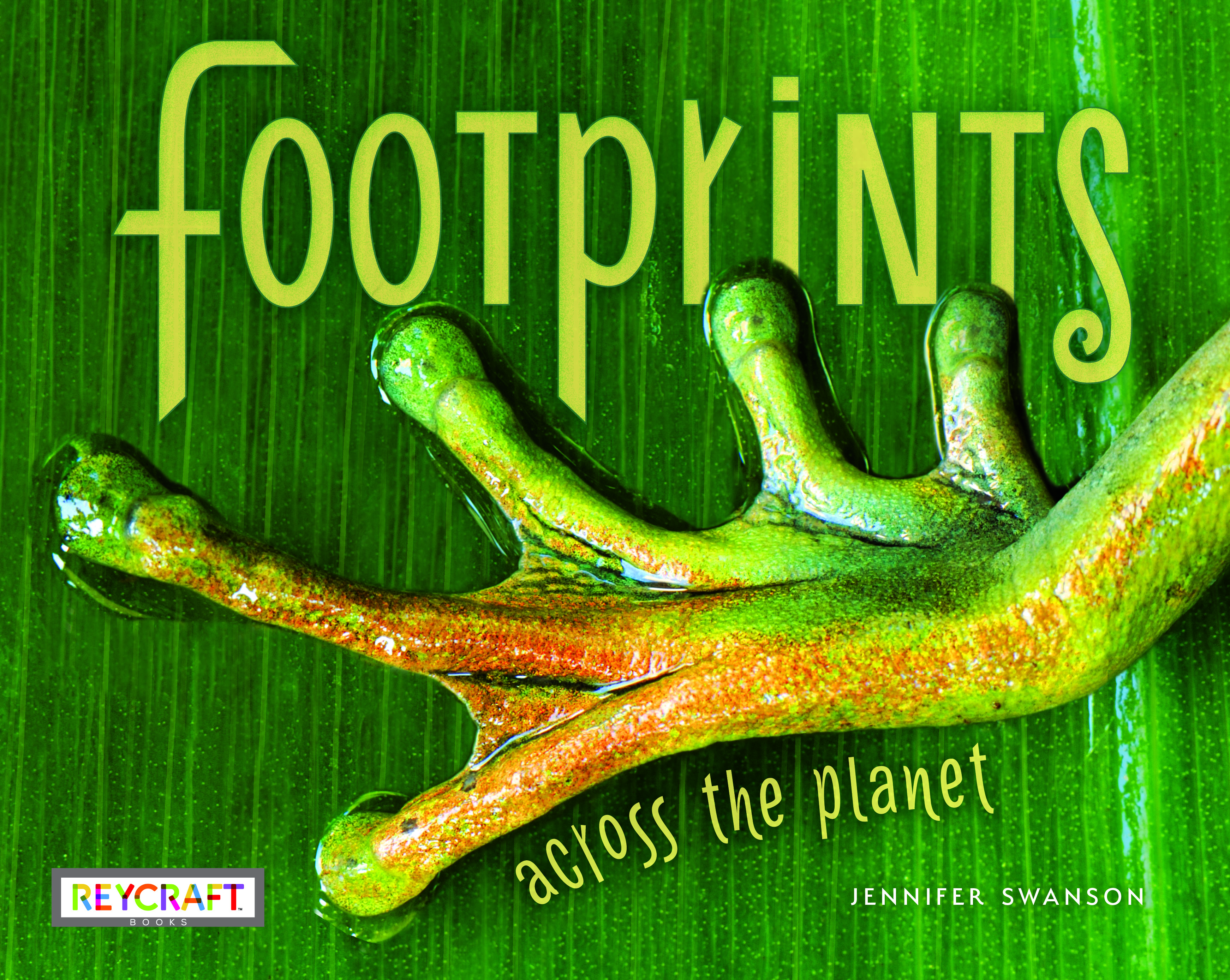
Footprints Across the Planet
written by Jennifer Swanson
A beautiful poem about the footprints we leave across the planet - both physically and metaphorically.  With poetic lines, Swanson leaves us with some big ideas about the footprints we leave all around us.  Beautiful, full-layout photos go along with the lines that will leave readers thinking about these big ideas.  Going from animal footprints to human, to those we see on the ground (for long and short times), to the footprints we are leaving on this earth that show we are here (some good, some bad).  The backmatter has additional information about the photographs and ideas in the layouts.  Whether you share this book around Earth Day or at any point in the year, it's a great springboard for talking about the environment.

Blips on a Screen: How Ralph Baer Invented TV Video Gaming and Launched a Worldwide Obsession
Blips on a Screen
written by Kate Hannigan
illustrated by Zachariah Ohora
Video gaming is well-known by young readers, but how did it get its start?  This biography goes step by step of how Ralph Baer started with the idea of gaming on television to making it happen.  The backmatter gives loads of more information, including that Baer also invented the game of Simon - that's one that provided lots of gaming time in my youth!

The Mystery of the Monarchs: How Kids, Teachers, and Butterfly Fans Helped Fred and Norah Urquhart Track the Great Monarch Migration
The Mystery of the Monarchs
written by Barb Rosenstock
illustrated by Erika Meza
This was a fascinating story!  The monarch is Illinois' state insect, and I always make sure to plant some flowers and plants to attract monarchs to my backyard every year.  
We know that monarchs migrate south every year, even know that many make the trek all the way to Mexico.  But how did we discover that?  That's Fred Urquhart's story!  Rosenstock tells us about Fred's love for these winged insects and his curiosity about where monarchs went when it got cold.  It's really interesting to read about all the steps and travels they took to find the answer to the mystery!

My Blue-Ribbon Horse: The True Story of the Eighty-Dollar Champion
written by Elizabeth Letts
illustrated by Kayla Harren
There seem to be quite a few books written lately about true stories of horses and this one will be a welcomed addition!  It's the story of a horse that was saved from being sent to the slaughterhouse.  Never thought to be more than a horse students could ride, this special horse went on to be a champion jumper!

The Rise (and Falls) of Jackie Chan
The Rise (And Falls) of Jackie Chan
written by Kristen Mai Giang
illustrated by Alina Chau
I know who Jackie Chan is, I've seen him in some movies.  I mostly know him by his fighting in movies and those faces he makes!  I loved being able to dive into his past and learn more about him.  I'm glad he is someone who knew who he was and wasn't going to change that to fit into the mold others wanted!

Moving Forward: From Space-Age Rides to Civil Rights Sit-Ins with Airman Alton Yates
written by Chris Barton
illustrated by Steffi Walthall
This is fascinating and equally frustrating to read.  It's about Airman Alton Yates' life - going from the work he did in the Air Force, including putting his body through crazy stunts all to improve safety for those protecting the country's freedom.  Then going back home to segregated Florida and not be served at counters or be given the same rights as whites.  Then Yates put his body through new rigors - some physical, some verbal and mental.  All to protect basic freedoms.  


Hope you found some new nonfiction books to add to your collection this fall!

Tuesday, July 26, 2022

Pigeon and Cat - a review 7.26.22

A story about compassion, about gift-giving, and about letting others in.  A character who changes.  Characters who know just what the other needs.  This is a beautiful story for young readers today.

Pigeon & Cat
by Edward Hemingway
published by Christy Ottaviano Books


Cat has always lived on his own, in an old abandoned lot.  He has just what he needs and doesn't need anything to change.  But when he finds an egg that is so beautiful he can't even eat it, and he decides to bring it home is when his character starts to change.  For once Pigeon hatches, they form an unbreakable bond.  Communicating through cat-speak and pigeon-emojis (it's really cute), the two help each other out and grow as characters.  Cat gives Pigeon the unconditional love that allows him to flourish and explore.  On Pigeon's explorations, he brings home little gifts for Cat that allow him to explore his artistic side in his abandoned lot.  But when Pigeon doesn't come home after a storm, Cat must venture outside his little area to find his BFF.  While searching for his friend, Cat befriends other community members and shares his artistic side, something he's only shown Pigeon.  Cat learns that the outside world isn't quite as scary as he thought and lets new people into his world. I love that the strays of the world get so much love in this story! But does Pigeon find his way home?  No spoilers, but after all, it is a picture book :)


Just take a look at these beautifully illustrated layouts by creator, Edward Hemingway!  I love the urban colors and the busy-ness of the city!  Hemingway shares he created the illustrations during the height of the pandemic, and just like Cat, he's sharing it now with the wider world!  Kind of a neat parallel!  I love all of the chalk messages throughout the book and it did remind me of what we saw during the pandemic.  It is a beautiful way of sharing a message of positivity and hope with others in your community.


Check out what others had to say about the book:

“A satisfying story exploring heart and home."  —The Horn Book


"A sweet tale celebrating the joys of both personal and communal togetherness." —Kirkus Reviews

Edward Hemingway is the acclaimed creator of many popular books: Tough Cookie: A Christmas Story, Field Guide to the Grumpasaurus, and Bad Apple: A Tale of Friendship. His writing and artwork have been published in the New York Times and GQ Magazine, among others. The youngest grandson of Ernest Hemingway, he lives in Bozeman, Montana. He invites you to visit him at edwardhemingway.com.

Twitter: @EdwardHemingway

Instagram: @edwardhemingway


A charming video on the backstory behind Pigeon & Cat:

https://vimeo.com/626765984


This would be a beautiful story to share with young readers at the beginning of the year.

Thank you to Barbara at Blue Slip Media for the review copy!